|
When Siemens A.G. (Munich) releases
the compact mainframe computer Siemens 404/3, Austrosoft co-founder H. Syrowatka
is put in charge of OS maintenance and further development. H.S. authors the
OS/Assembler manual, produces various system utilities, and assists in
introducing the system into the market mainly by converting existing
software. At the same time cooperation with other developers and groups begins.
Software
for the 404/3 is developed, later other Siemens systems follow. A few of the jobs completed:
The conversion of a FORTRAN IV weather forecasting package for Deutsche
Wetterwarte, Frankfurt
(the German meteorological service) falls within the purview of 404/3 support
tasks.
Assembler development of an IBM-CICS emulation package in cooperation
with Softlab AG, Munich. The software enables IBM CICS applications to run
under control of the Siemens BS1000 transaction monitor ASMUS
Conversion of the AVBOB IBM site to a Siemens System 7.531 for
Siemens Ltd. Johannesburg.
Conversion of programs in preparation of benchmark testing for Siemens
Ltd. in aid of the bidding for various tenders |
|
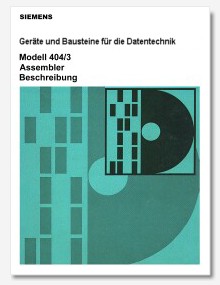
Siemens 404/3, Systems Manual and
Assembler Programmers Guide,
authored by H.F. Syrowatka |
|
Conversion of a FORTRAN IV CAD package
for South African steel producer ISCOR |
|

|
|
The construction of a new Transnet
railroad
marshalling yard at Bapsfontein, ("Sentrarand", still the largest facility of its kind in the
southern hemisphere), necessitates the
installation of a broad range of electrical and electromechanical gear, electronics,
networking systems, computer
hardware and software.
Siemens AG (Munich) and
Siemens Ltd. (Johannesburg) are awarded the contract under which duplicated,
fail-safe computer systems, capable of running yard operations 24x7,
are to be developed. A "hot standby" system of 2x3 interlinked mainframe,
front-end, and network computers is
proposed and implemented. The software is jointly developed by two
groups, located in Germany and South Africa; H. Syrowatka is appointed
"Team leader for system software and OCS (Operations Control System)
integration" of the South African group and performs this function through a 2½-year period until
successful project completion. The tasks involved require the development of
low-level device drivers and a mid-level API layer written in assembler language,
to support COBOL applications programming
|
|

 |
|

|
|
Contracted by Johannesburg merchant
bank Mercabank Ltd. for an eight month period to run and upgrade the 'orphaned'
computer installation until suitable new staff can be found and trained; the
contract is later extended to incorporate the development of a 'general ledger'
package, written in BS2000 assembler, to run on the Siemens 7.531 mainframe
|
|
 |
|
Contract work for Standard General
Insurance (StanGen) results in the assembler modules SISAM and SISAMT, which
stabilize the existing flat-file database system by adding efficient record
locking and deadlock resolution features |
|
 |
|
Chemical firm Bayer SA requires
additional human resources to cope with a backlog of COBOL programming |
|
 |
|
Contracted on various occasions by
Siemens Ltd. and Siemens-Nixdorf Ltd. for assembler-based developments |
|
 |
|
Design and
implementation of ConPLAN, a comprehensive
compiler/emulator package for ICL 1900/2900 PLAN programs.
ConPLAN
emulates the ICL 1900/2900 instruction set, I/O system, and OS services. It enables ICL PLAN Assembler programs to execute on IBM / Siemens
mainframes while at the same time supporting
program maintenance by means of the built-in PLAN compiler
functionality.
The package is used for several years as "virtual machine" for ICL assembler
programs that process and print the South African and Namibian telephone and
fax directories (dubbed "white and yellow pages")
The Siemens-Nixdorf Unix-derivative Sinix is chosen to handle communications
between the Siemens mainframe running ConPLAN and the print shop hardware, a
Linotron photo setting machine (the connection module 'Linotran' implements a
proprietary transmission protocol build on RS232C) |
|
 |
|
Contracted by Nasionale Pers/Perskor to
produce a machine language run-time interface module that enables certain Unix
COBOL programs to communicate with the Siemens BS2000 API's |
|
 |
|
After 2005, the focus shifts from mainframe to client/server and web server
platforms. Programming and systems development concentrate on the
Microsoft/Intel platform in combination with Borland software tools
|
|
 |
|
Various projects
have since been completed, a few posted on the Internet. One experimental application
enables UDP-based Internet communications between clients with
dynamically allocated IP addresses without arbitrating server by exploiting the
SMTP/POP3 protocols to achieve a sustained exchange of messages in
near real-time (delay < 5 seconds).
A C++ demonstrator project results in a nautical navigation program, which
allows the user to manage a mixed archive of paper and electronic charts. Plans
are to integrate a public domain database of the "coastlines of the world" and
combine the information with relief data to create a false-colour screen
display, onto which a continuously updated GPS-derived position can be
superimposed |
|
 |
|
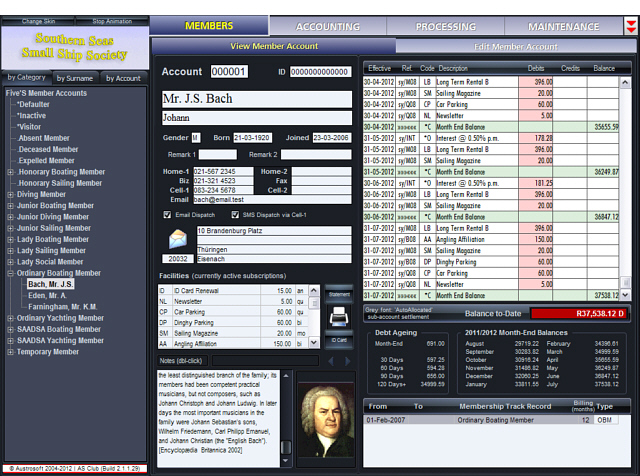
In January 2006 the first beta-version of AS Club is released
for download from the
Austrosoft website.
The application combines the functions of accounting and management support in
a newly developed package,
aimed at clubs and various other membership organizations. Internet connectivity enables a club to
reach
its members electronically via database-controlled email- and SMS-dispatches. A
club can also run its website in-house, turning its own computer
into a web server; this functionality allows members to query their accounts online.
Members can also send instant messages
back to the club computer - they are immediately received and displayed by AS
Club.
Payments made into the club bank account can be imported from electronic
bank statements in OFC/OFX (i.e. Microsoft Money™) file format.
Added
in are convenience features, among them the printing (and automatic reprinting) of club
ID cards, a webcam interface, allowing member photographs to be taken on
site and
imported directly into the database, and the support of flatbed scanners.
Multiple users can synchronize their local databases with the online 'master
copy'.
A special 'one-click' feature allows the user to send the encrypted and
compressed database to Austrosoft for diagnostic purposes.
Highest on the list of priorities are the stability of the system and its ease
of use through an intuitive user interface. AS Club is coded in C++ and
comprises some 120k loc |
|
 |